The Grand Canyon: Planning Your First Visit to the South Rim
Inspired already? Get a personalized day-by-day itinerary for Grand Canyon South Rim, Arizona, USA in minutes — free.
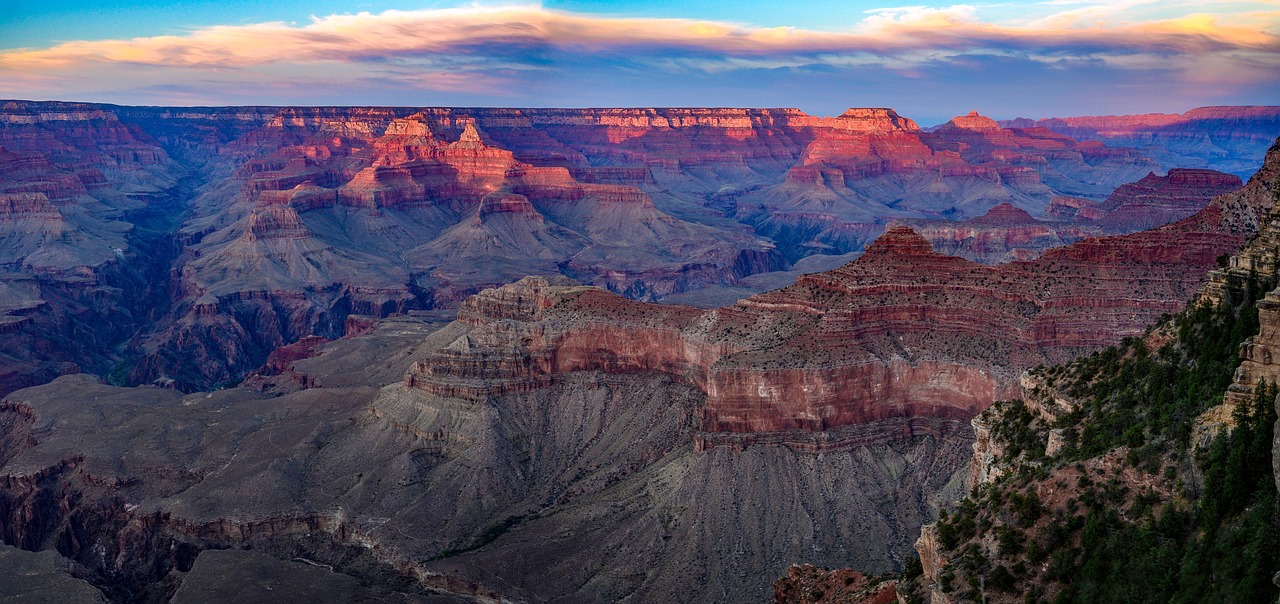
Plan this tripThe statistics are absurd — 446 kilometers long, up to 29 wide, 1.8 deep, with nearly two billion years of Earth's history exposed in its walls — but the Grand Canyon isn't really about numbers. It's about the moment you walk up to the rim and your brain briefly refuses to process the scale. Ninety percent of visitors see it from the South Rim, and for a first trip, that's exactly where you should go.
When to visit
The South Rim is open year-round at 2,100 meters elevation, which surprises people: winter brings snow-dusted red rock and near-empty viewpoints, while July afternoons regularly hit thunderstorm hour like clockwork. The sweet spots are April-May and September-October — mild rim temperatures, manageable crowds, and safe conditions for hiking below the rim. If you come in summer, structure your days around dawn and dusk; midday is for the shady rim path and the excellent Yavapai Geology Museum.
The viewpoints that matter
- Mather Point: steps from the visitor center and mobbed for a reason — it's a stunning first look.
- Hopi Point: the sunset classic, jutting far enough into the canyon for 270-degree views of the Colorado River.
- Desert View: 40 km east, where the river makes its great bend beneath the 1932 stone Watchtower.
- Shoshone Point: an easy, little-known 1.6 km walk to a promontory most visitors never find.
Hiking below the rim — safely
Everything changes the moment you drop below the rim: the crowds vanish, the silence deepens, and the temperature climbs roughly 5°C for every 300 meters of descent. The golden rule is that going down is optional, coming up is mandatory — and takes twice as long. First-timers should aim for Ooh Aah Point (South Kaibab Trail, 2.9 km round trip) or Cedar Ridge just beyond it, or the 4.8 km round trip to Mile-and-a-Half Resthouse on Bright Angel Trail, which has water and shade. Rim-to-river-and-back in one day is not a hike; it's a rescue statistic. Don't.
Where to stay
Staying inside the park is the move if you can get it — El Tovar and Bright Angel Lodge put you steps from the rim for sunrise, and bookings open 13 months out. Tusayan, ten minutes south, is the overflow with chain hotels. Williams (60 minutes) adds Route 66 kitsch and the Grand Canyon Railway, a genuinely fun vintage train that rolls right to the rim. Flagstaff (90 minutes) is the pick if you want a real town with a craft beer scene and dark-sky stargazing.
Practical tips
- The park's free shuttle system is excellent; the Hermit Road viewpoints are shuttle-only most of the year.
- Carry (and drink) far more water than feels reasonable — a liter per hour while hiking in summer.
- The canyon is a certified International Dark Sky Park; stay past twilight at least once.
- Book mule rides and Phantom Ranch stays a year or more ahead.
Two full days is the minimum that does it justice: one for the viewpoints and rim trail, one to get below the rim at dawn. You'll leave already planning the return trip — probably eyeing the wilder North Rim.
Ready to plan this trip?
Let VacayPlot's AI craft a personalized day-by-day itinerary for Grand Canyon South Rim, Arizona, USA — free.
Plan this trip